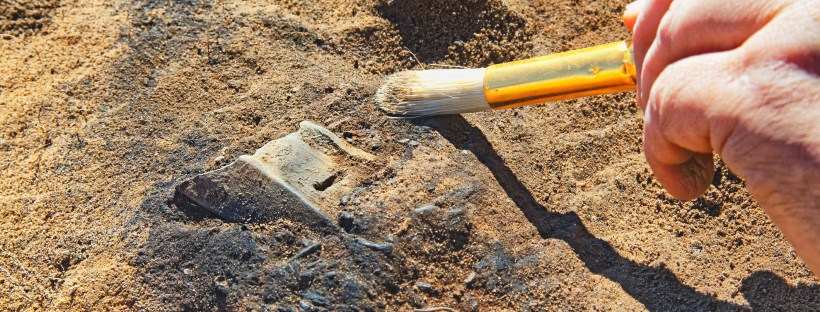
Archaeologists have unearthed a 2,700-year-old headless Assyrian sculpture at the site of the ancient city of Khursbad in northern Iraq. It was first discovered in 1992 but was quickly reburied to protect it against looters.
A joint Iraqi-French team re-excavated the enormous statue, which once formed the gate at the entrance to the city. “I’ve never unearthed anything this big in my life before,” remarked Pascal Butterlin, leader of the French archaeological team. “Normally, it’s only in Egypt or Cambodia that you find pieces this big.”
Even without a head, the 18-tonne alabaster sculpture measures a whopping 3.8 metres by 3.9 metres. It depicts an Assyrian protective deity known as a Lamassu, which has the head of a human, the body of a bull or lion, and the wings of a bird.
The substantial statue was originally commissioned for the new capital city of Assyria, Khursbad, under the reign of King Sargon II (c. 770-705 BC). But following his death, Sargon II’s son Sennacherib (c. 745-681 BC) moved the capital city and abandoned the site. The ruins of the lost city were first discovered by French archaeologist Paul-Émile Botta in 1842, but it was not until 1992 that an Iraqi archaeological team found the Lamassu statue on the western side of the site.
By this point, Iraq had undergone years of economic embargos. Antiquities thefts started to rise, which resulted in the head of the Lamassu being stolen in 1995. Thieves attempted to smuggle the sawn-off head out of the country by breaking it into 11 pieces.
Authorities later recovered all the pieces of the missing head and decided to rebury the rest of the statue for its protection. The Iraqi State Board of Antiquities and Heritage (SBAH) is assessing ways to finally reunite the newly uncovered statue with the damaged head, which is currently housed in the Iraq Museum in Baghdad.
“The attention to detail is unbelievable,” said Butterline. “We can now study the whole context of this beautiful gate which might still be in very good condition.”
 Art Law & More