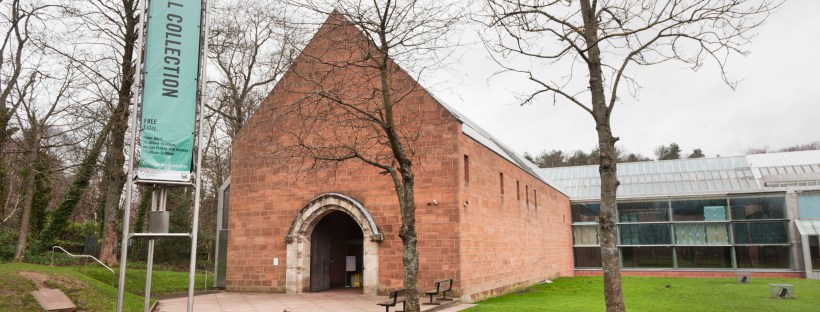
The Burrell Collection on the outskirts of Glasgow in Pollok Country Park has been awarded the prestigious Art Fund Museum of the Year award, which comes with the generous prize money of £120,000. The Scottish museum has beaten finalists Leighton House and the Natural History Museum in London, The MAC in Belfast and the Scapa Flow Museum in Orkney, although each of these institutions received £15,000 for their spot as runner up.
Glaswegian shipping magnate Sir William Burrell and his wife Constance, Lady Burrell were responsible for the formation of the Burrell Collection. Sir William started collecting at a young age, first having a particular interest in 19th century French art, but later expanding to diverse fields. He donated the 6,000-object collection to the city of Glasgow in 1944 but continued to add to it until his death in 1958, the result being a collection of nearly 9,000 works of art. Highlights include a 15th century stained-glass window depicting Princess Cecily, which was once at Canterbury Cathedral; Edgar Degas’s The Red Ballet Skirts (c.1900); and a self-portrait by Rembrandt van Rijn (1632). Mary Beard, one of the judges of the Art Fund’s award, described it as a “treasure trove of objects to discover” and said that the institution held “one of the UK’s most important collections of Chinese art”.
The collection closed for a major refurbishment in 2016 and was only reopened in October 2022. It is most certainly the redisplay which has contributed to the museum’s win. In March 2022, Joanna Moorhead wrote in The Art Newspaper that “collections do not come much more steeped in white, male, wealth-driven narrative than this one”, and the museum’s staff have evidently worked hard to make the museum engaging and relevant for a 21st century audience. New interpretation includes immersive experiences and digital technologies. Jenny Waldman, director of the Art Fund, said that “the sensitive renovation and collection redisplay invite exploration and delight, with innovative digital displays offering new ways of understanding the art and objects in the museum’s light, welcoming spaces. All this was achieved with a strong shared purpose and with the involvement of local community groups in Glasgow.” Mary Beard spoke similarly positively about the renovation, saying that the museum “have realised, with real rigour and imagination, the true depth of what it means for a museum to be accessible.”
Despite the positive outlook for the Burrell Collection, Glasgow Life – the charitable organisation which manages museums for Glasgow City Council – have recently proposed 37 redundancies out of a total of 128 positions to the museums and collections team. The Museums Association policy officer, India Divers, said, “we are concerned by the proposed staff cuts at Glasgow Museums that will result in a reduced public programme and fewer exhibitions.”
In contrast, Scotland’s Scapa Flow Museum, who came second in the Art Fund prize, were enthusiastic about their outlook. Nick Hewitt, team leader for culture of Orkney Islands Council told BBC Radio Orkney that being on the shortlist had brought the museum national and international coverage. At the ceremony, Hewitt enthused: “we genuinely are thrilled to be here. It feels like we’re all winners.”
 Art Law & More