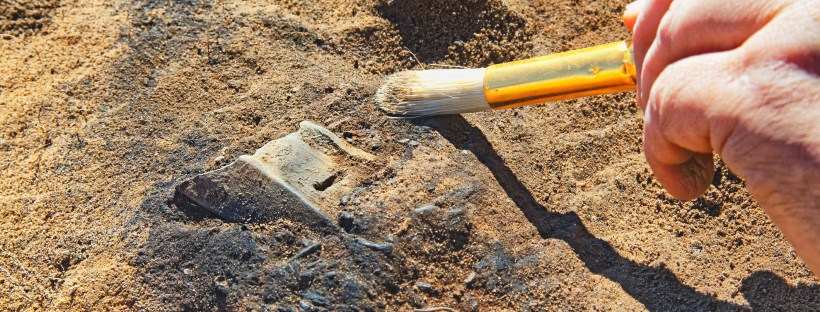
The Museum of London Archaeology (MOLA) team have discovered an “extremely rare” Roman mausoleum, alongside some of the largest and most intact ancient mosaics ever found in Britain. It was unearthed below a South London construction site, just moments away from Borough Market and The Shard.
“It provides a fascinating window into the living conditions and lifestyle of this part of the city in the Roman period,” remarked Antonietta Lerz, senior archaeologist at MOLA.
Experts believe the astonishingly well-preserved building, which was possibly two storeys high, would have been used by wealthy Romans as a family tomb. The “completely unique” discovery included the walls of the mausoleum, the interior floors, entrance steps, and a raised platform on which burials were placed. Inside the mausoleum there is a striking monochrome mosaic with concentric circles framing a floral motif. Another similar mosaic was found directly beneath the first one, suggesting the floor was raised at some point.
“This relatively small site in Southwark is a microcosm for the changing fortunes of Roman London,” explained Lerz. “From the early phase of the site where London expands and the area has lavishly decorated Roman buildings, all the way through to the later Roman period when the settlement shrinks and it becomes a more quiet space where people remember their dead.”
There were also more than 100 coins scattered around, some scrap pieces of metal, fragments of pottery and roofing tiles. Although no burials were found inside the building, the surrounding site contained more than 80 Roman burials that were accompanied by copper bracelets, glass beads, coins, and pottery.
Last year, the largest Roman mosaic found in London for over 50 years was also uncovered at the site. MOLA led the dig on behalf of the site’s owners Landsec and Transport for London (TfL), and Southwark council. After a period of extensive excavation, the area will be redeveloped into a complex of offices, homes and shops called The Liberty of Southwark.
Southwark council cabinet member Catherine Rose confirmed that the exceptional discoveries would be preserved and made accessible as “a testament to the rich tapestry of our past.” In the meantime, history-lovers can peruse a fascinating three-dimensional model of the site made by archaeologists at MOLA.
 Art Law & More