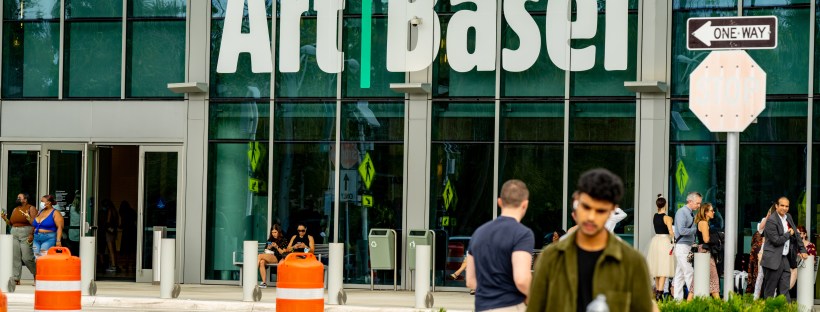
Art Basel has opened its doors to the art world’s A-listers for its ‘VIP Day’. Amongst the star-studded crowd were names like Jennifer and David Stockman, Benedikt Taschen, Udo Brandhorst, Li Lin, and Maja Hoffmann.
Despite growing apprehension about the art market, the event was buzzing with optimism. “We need the market to do what it does, but in terms of audience, this couldn’t be going better,” said Noah Horowitz, CEO of Art Basel, early on in the day. “Asia completely showed up, and there are a lot of Americans here. I feel proud. It’s the real deal. You just see the incredible trust we have from this community, from these galleries and their artists and collectors.” Andrew Fabricant, Gagosian’s COO, was also pleasantly surprised, describing it as “the busiest in years”.
Reflecting the opening’s dazzling clientele, this year’s works on offer were of the highest calibre. The most expensive work sold on the first day was the iconic bronze sculpture ‘Spider IV’, created by a French-American artist Louise Bourgeois (1911-2010) in 1996. It sold through Hauser & Wirth for a whopping $22.5 million (£17.8 million) to a US collector. The gallery also sold a painting by the Canadian-American artist Philip Guston (1913-1980) for $9.5 million (£7.5 million). Another star of the show was presented by David Zwirner – a new digital print sculpture called ‘STRIP-TOWER’ (2023) by German artist Gerhard Richter, which sold for $2.5 million (£1.9 million).
There were still several major pieces, however, that had not sold by the first day. This included Mark Rothko’s (1903-1970) ‘Untitled (Yellow, Orange, Yellow, Light Orange)’ (1955), which remained on sale at Acquavella for $60 million (£47 million). “A lot of major works get sold on the second and third day, and that’s generally been the case for the past five years,” explained Samanthe Rubell, president at Pace Gallery. “We leave room for happy accidents to happen but make sure that our artists’ work gets into the most important collections.”
Art Basel’s success follows a rocky year for the art market. Contemporary art adviser Nilani Trent believes that “inflation, interest rates, politics and an ongoing war are all affecting consumer confidence, causing a slowdown of the art market.” According to art dealer David Nolan, the people who journey to Art Basel each year budget specifically to buy at the event, and therefore they are “less affected” by the fluctuations in the wider market.
 Art Law & More